Annapurna Bhandar Scheme (Annapurna Yojana) in West Bengal
Last Updated
21 July 2026 | 7:45 pm | By SchemeWala
Quick Summary
| Detail | Information |
|---|---|
| Scheme Name | Annapurna Bhandar (Annapurna Yojana) |
| Launched By | West Bengal Chief Minister Suvendu Adhikari (at Nabanna) |
| State | West Bengal |
| Beneficiaries | Eligible women aged 25 to 60 from low-income / EWS households |
| Monthly Benefit | Flat Rs 3,000 per month |
| Mode of Payment | Direct Benefit Transfer (DBT) to bank account |
| Official Portal | West Bengal social security portal (socialsecurity.wb.gov.in) |
| Status | Operational (first transfers began 3 June 2026) |
About the Scheme
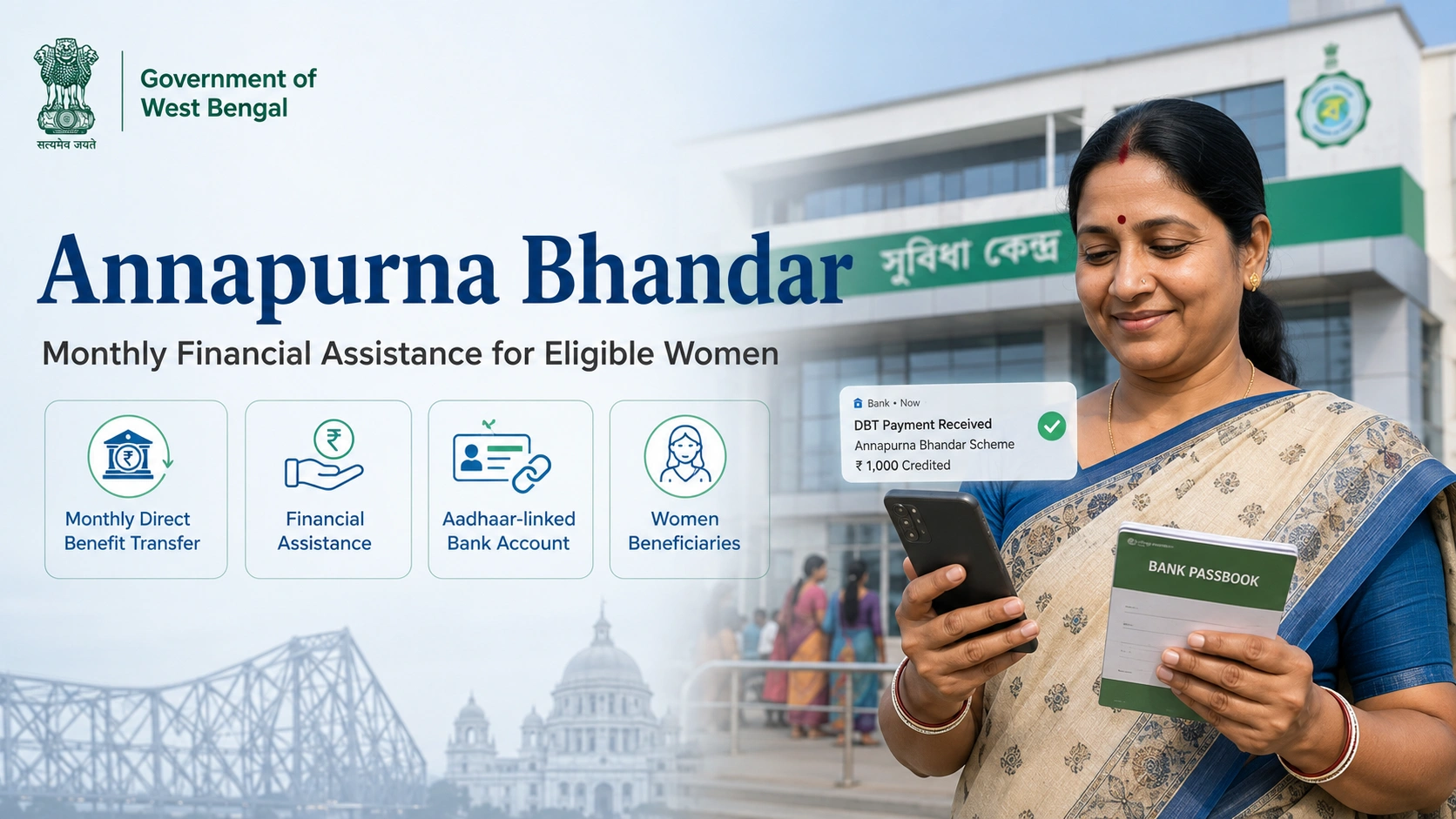
The Annapurna Bhandar scheme, also referred to as the Annapurna Yojana, is a new version of Lakshmi Bhandar scheme - women-centric direct income support programme run by the Government of West Bengal.
It was launched by West Bengal Chief Minister Suvendu Adhikari at Nabanna, and the first fund transfers began on 3 June 2026. Under the scheme, every eligible woman receives a flat Rs 3,000 per month credited directly to her bank account through Direct Benefit Transfer (DBT).
The aim is to put a predictable, monthly amount into the hands of women from lower-income households so they can meet everyday needs with greater dignity and independence.
Annapurna Bhandar replaces the earlier Lakshmir Bhandar scheme. The most important change is that it removes the older tiered structure: instead of paying different amounts based on social category, Annapurna Bhandar pays the same flat Rs 3,000 to every eligible woman.
In its first phase, about 28,25,769 women received the first Rs 3,000 transfer, and the eventual target is roughly 2 crore women. The West Bengal Budget 2026 set aside about Rs 36,000 crore for the programme. Alongside approving the scheme, the state cabinet also cleared free travel for women on all state-run buses, adding to the basket of women-focused welfare measures.
Key Benefits
- A flat Rs 3,000 is credited every month directly to the beneficiary bank account.
- Payments are made through Direct Benefit Transfer (DBT), which reduces leakages and removes middlemen.
- Every eligible woman receives the same amount regardless of social category, unlike the older tiered structure.
- The scheme is aimed at supporting women from low-income and economically weaker section (EWS) households.
- It is complemented by free travel for women on all West Bengal state-run buses.
- A large budget allocation of about Rs 36,000 crore signals a long-term commitment to the programme.
Eligibility Criteria
- The applicant must be a woman resident of West Bengal.
- The applicant should be aged between 25 and 60 years.
- The applicant must NOT be an income-tax payer.
- The applicant must NOT hold permanent government employment or receive a regular salary or pension from the central or state government, statutory bodies, government undertakings, panchayats, municipal bodies, local authorities, or government-aided educational institutions.
- The scheme is generally targeted at low-income and economically weaker section (EWS) households.
- Final eligibility is determined as per the official West Bengal government notification.
Documents Required
- Aadhaar card
- Bank account passbook (for the DBT credit)
- Residence or domicile proof of West Bengal
- Age proof (such as a birth certificate, school certificate, or Aadhaar)
- Passport-size photograph
- Any additional documents as specified in the official notification
How to Apply
The Annapurna Bhandar scheme is operational, and the first Direct Benefit Transfers were made on 3 June 2026. However, a detailed, officially documented step-by-step application procedure is not confirmed here. The official application process is expected to be announced by the government — check the official portal for updates. Rely only on the official West Bengal social security portal (socialsecurity.wb.gov.in) and your local government offices for the correct, current process, and do not share documents through unofficial channels.
- Keep your Aadhaar card and West Bengal residence proof ready.
- Ensure your bank account is active and linked to Aadhaar so DBT payments can be credited.
- Watch the official portal (socialsecurity.wb.gov.in) for enrolment announcements and windows.
- Verify any process at official government offices before submitting documents or personal details.
Common Mistakes to Avoid When Applying
- Sharing your Aadhaar, bank, or OTP details with unofficial agents or websites that claim to register you. Trust only official channels.
- Assuming you are enrolled automatically. Confirm your status through official sources rather than relying on rumours or forwarded messages.
- Providing an inactive or non-Aadhaar-linked bank account, which causes DBT payments to fail.
- Name or spelling mismatches between your Aadhaar, bank records, and application details.
- Ignoring the eligibility exclusions. Income-tax payers and government employees or pensioners are not eligible.
- Paying any processing fee. Government DBT schemes like this do not charge citizens to apply.
Important Dates & Status
Annapurna Bhandar is currently operational. It was launched by Chief Minister Suvendu Adhikari at Nabanna, and the first Rs 3,000 transfers began on 3 June 2026, reaching about 28,25,769 women in the first phase. The scheme is backed by the West Bengal Budget 2026 with an allocation of roughly Rs 36,000 crore, and the government has set an eventual target of around 2 crore women beneficiaries. For the latest enrolment windows and payment dates, refer to the official West Bengal social security portal.
Frequently Asked Questions
How much does Annapurna Bhandar pay?
Eligible women receive a flat Rs 3,000 per month through Direct Benefit Transfer to their bank account, regardless of social category.
Does Annapurna Bhandar replace Lakshmir Bhandar?
Yes. Annapurna Bhandar replaces the earlier Lakshmir Bhandar scheme and removes its earlier tiered payment structure in favour of a flat Rs 3,000 for every eligible woman.
Who is eligible for the scheme?
Women residents of West Bengal aged 25 to 60 who are not income-tax payers and do not hold permanent government jobs or receive a regular government salary or pension, generally from low-income or EWS households. Final eligibility follows the official notification.
When did payments start?
The first transfers began on 3 June 2026, with about 28,25,769 women receiving the first Rs 3,000 in the initial phase.
How will I receive the money?
The benefit is paid via Direct Benefit Transfer (DBT) directly into the beneficiary bank account, so an active, Aadhaar-linked bank account is important.
Official Sources
Always verify details from official and reputable sources: West Bengal social security portal (socialsecurity.wb.gov.in), Government of West Bengal (wb.gov.in), News on AIR (newsonair.gov.in), and reputable news outlets such as The Indian Express, The Economic Times, and The Times of India.
Related Schemes
PM Poshan Shakti Nirman Scheme
Discover how the PM POSHAN (Mid-Day Meal) scheme works in 2026. Learn about the 100%…
Pradhan Mantri Matru Vandana Yojana
Decode the PMMVY 2026 maternity scheme. Learn how to claim ₹5,000 for the first child,…
Integrated Child Development Services
What are you legally entitled to at your local Anganwadi? Learn about the ICDS (Poshan…
One Stop Centre Scheme
Facing domestic violence or assault? Learn how the One Stop Centre (Sakhi) provides 100%…